

A simple FX dashboard that places Nigeria’s street and official Naira rates side by side for clearer decisions.
I work with international clients, and I’m often moving between currencies, proposals, and invoices. Somewhere between drafting a contract and sanity-checking a rate on yet another website, I realised how fragmented the experience was. Parallel market estimates on one site, official reference rates on another, rumours in group chats, half-updated dashboards. Nothing felt coherent.
I didn’t want a perfect model of the Nigerian FX market. I wanted something that made the day-to-day less chaotic.
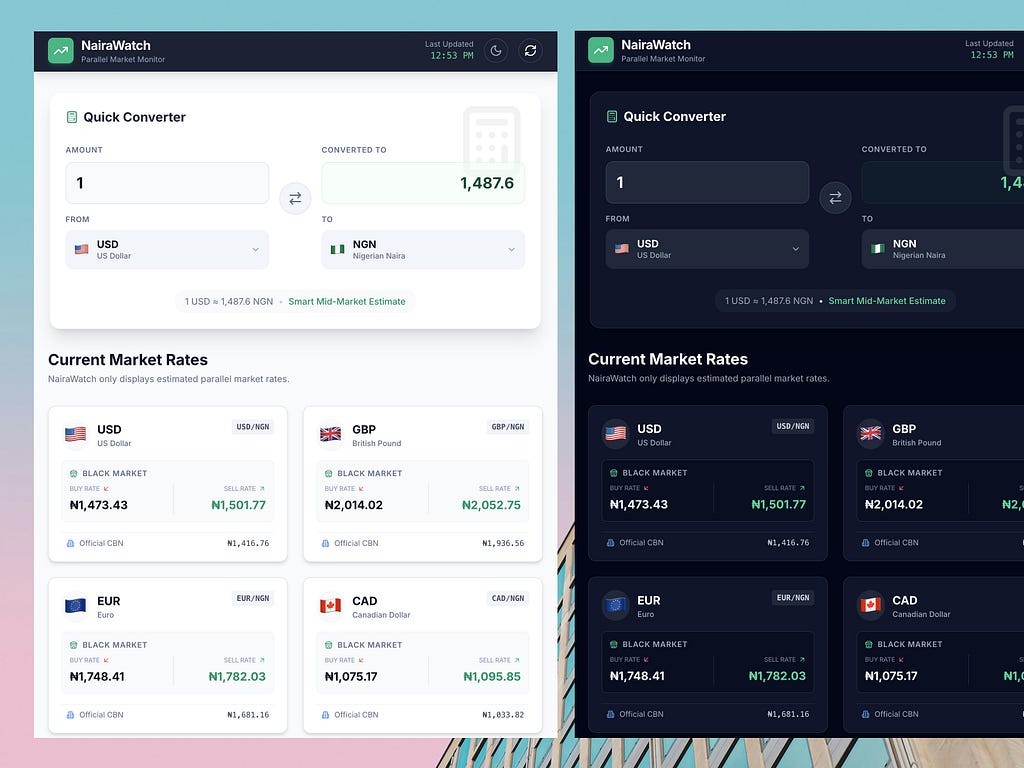
So I built NairaWatch. It tracks daily Naira estimates across 60+ currencies, putting parallel market signals next to official CBN rates. It doesn’t predict the future. It gives you a snapshot of where things are, so you can make slightly better decisions today.
How the data works
The official rates come from a free exchange rate API (exchangerate-api.com). The parallel market estimates are generated by prompting LLMs, primarily LLaMA 3.3 70B on Groq, with fallbacks to Gemma and Qwen models through OpenRouter. The prompt asks for current street buy/sell rates, and the response gets merged with official cross-rates. If the AI calls fail, it falls back to a 4–6% markup over the official rate.
The build
The frontend is React with TypeScript, built with Vite, styled with Tailwind (loaded from CDN). The API runs on Cloudflare Workers. I started prototyping in Google AI Studio, then moved into actual code. The AI providers (Groq, OpenRouter) were the interesting part, not as a coding assistant, but as the data source itself.
Deployed on GitHub Pages. Pushed to GitHub, iterate, repeat.
What it’s for
People who work across borders: freelancers, founders, and consultants who need to think in more than one currency at a time. It doesn’t solve the broader questions about value and uncertainty. It just puts the numbers side by side so you can see patterns instead of guessing.
What’s next
I’m more interested in depth than scale. Better ways to combine and explain the signals. Making trends over time more visible. Maybe applying this same approach to other messy systems where a little clarity helps.
Check out NairaWatch — Parallel Market Monitor